Friday, 21 May 2010

Building scale models of aircraft in LEGO.

I get asked how I build my aircraft so often that I decided to make it the subject of a post. It seems like a far better idea than me waffling somewhere in the comments on my photostream or in some discussion group.

Making a plan
I know that a lot of builders start with a bunch of more-or-less random parts or a nice connection between a few of them and fiddle around with those until they find a shape they like, at which point they decide what it is that they'll build. I don't build like that. I know exactly what I'll build before I start and I often know how I'll build it in quite a lot of detail. I look at pictures of the real aircraft already thinking of how to build it and I make a plan. The plan can include a number of things, but usually involves the following things

  • a drawing showing the dimensions of various parts of the aircraft

  • a design of how to recreate the shape of the wings

  • an idea of what the most difficult bits will be


How detailed the plan is and how much of it I work out on paper differs from aircraft to aircraft. The paper version can consist of a small sketch showing some of the dimensions- but sometimes is pretty elaborate. Here are some examples.
drawings
If you look closely you'll see quite a few aircraft and helicopters that I have already built, as well as a fire engine and a few planes I haven't built yet.
I'll now go over the three points on my list in a little more detail, to show a few tricks and the advantages of having them in a plan in the first place.

Working out the dimensions
For finding the dimensions, I tend to use a three-view drawing of the aircraft. I look up its length or wingspan, calculate to how many plate widths those lengths correspond and from that work out to how many studs a cm in the drawing corresponds. I might download and print the plans from the internet and scribble on the printout or use drawings in a book as the basis for my own little drawing. In any case, I like to have a piece of paper next to me when I build. Alexk-, whose F-22 I blogged little more than a week ago, does something similar, but takes a more high-tech approach. Here you see a drawing of the F-22 with a scale superimposed on top of it, showing to how many plate widths the aircraft corresponds.


The shape of the wings
I always spend a lot of time on getting the leading and trailing edges of a wings and the horizontal tail plane the proper angle. Because I tend to build wings using plates (as opposed to using bricks on their side) this usually means using wedge plates. In the last few years, LEGO have introduced a whole range of wedge plates with different angles and often these are enough.

For some aircraft. however, the angle of the leading edge doesn't correspond to anything LEGO make. In that case a bit more creativity is required. Sometimes it is possible to use plate-hinges in combination with different wedge plates to get the proper angle.

Mike Psiaki's F-22, which I also blogged last week also uses the technique, as do the models of the Eurofighter Typhoon built by several people, including my own.
Eurofighter Typhoon (7)
A nice example of a plan, also for a Eurofighter, and with a similar wing design is John Lamarck's.

Sometimes using a little maths can come in handy. I promise not to go overboard on the equations this time, but the Pythagorean theorem can be very useful. It describes the relative lengths of the three sides of right-angled triangles. The sides of triangles with certain angles have integer lengths (phythagorean triples). These can be very useful, because using Pythagorean triples, you can make really sturdy triangles. One example is 3,4,5 (because 32+42=52, I did manage to sneak one equation in here after all).

In other words, the diagonal of a right-angled triangle with sides that are 3 and 4 studs long is exactly five studs long. I used this handy set of numbers to mount the complete wings of my A-7 Corsair at an angle.
A-7E Corsair II (1)
Certainly in the latter case, the way I built the wing had a huge impact on how I built the entire plane. If I hadn't planned this, it would never have worked.

The difficult bits
My plan tends to include some ideas of which bits of the plane will be difficult to build and those are the parts I build first. For my Sea Harrier they were the cockpit section, nose landing gear and the jet intakes.
Sea Harrier work-in-progress (1)
Sea Harrier FRS.1 (5)
If you look at the completed model, you'll see that the bits that were already present in the work-in-progress picture are still there almost completely unchanged.
Heinkel He-219 Uhu Work In Progress
Similarly, for my Heinkel He-219 Uhu I started with the cockpit, radar antennae and the engine cowls.
Heinkel He-219 Uhu (1)
Once the difficult bits are done, the rest of the build tends to be smooth and easy. Having a plan and knowing how big various parts have to be means I rarely rebuild parts of a MOC that I have already built. I also rarely start something that I don't finish.

I love it when a plan comes together!
The plans I drew before building my E-2C Hawkeye are among the more detailed I've done.
drawings (4)
I worked out the dimensions, I designed the outline of the wings, I figured out how to build the nose section and the radome and how the aft fuselage would taper; all before putting any bricks together. If you look closely at the wings you'll see that I've also the technique of combining wedge plates to get the proper angle for the wings. When building it there were still a few things I needed to sort out, but I ended up sticking pretty close to the plan.
E-2C Hawkeye (3)
Even though it was built more than two years ago, the Hawkeye is still one of my most complicated models and I don't think I could have built it without a plan.

This is not me trying to tell any of you to do things my way. Everybody should build how they see fit. Obviously there are other approaches, but having built a few dozen aircraft models in the last few years alone, I find that this approach is what works best for me. Perhaps some of you can use some of my ideas to your advantage.

Happy building!

Wednesday, 12 May 2010

Dr. Spontaneous

I was just looking through the LEGO Military group pool on flickr to see if I had missed anything, and was pleasantly surprised to discover a talented builder that I haven't heard of who goes by Dr. Spontaneous, so I'll be blogging a couple of fantastic vehicles that he posted a few days ago.

First up is the VDS Medium Adaptable Artillery Truck (which is apparently based on an older creation of his), complete with
stabilizing support struts:


Of equal note is his VDS Advanced Infantry Fighting Vehicle, which sports an anti-RPG cage and room for three dismounts:


It's not often that builders are able to incorporate working features and an interior into creations while still keeping them compact enough to be able to pass for being minifig scale, and Dr. Spontaneous has done both with flying colors. Keep it up!

Victory Day

PigletCiamek, yet another excellent builder from Poland, has built a cemetery for Soviet soldiers who were killed while fighting occupying German troops in Poland near the end of WWII - complete with a rusty T-34 perched on a monument - to commemorate the 65th celebration of Victory Day, which was observed this past Sunday on May 9 to mark the unconditional surrender of the German military and the end of the Third Reich. Similar to Victory in Europe Day (VE Day for short) that's observed in the West on May 8, Victory Day is observed in the East (albeit a day later, as the German surrender took place May 9 Moscow time), and is celebrated each day with the Victory Day Parade in Moscow.

My favorite part of the diorama itself is the former Soviet soldier in a wheelchair paying tribute to his fallen comrades, and the tilted part of the monument that the T-34 rests on is also an exceptionally nice detail.


Tuesday, 11 May 2010

Stealth

The current flickr Lego Military build contest has a category dedicated to stealth technology. The category is intended for fictional designs, but I felt it might be a good idea to take a little look at some stealthy aircraft built in Lego by various people and to explain a bit more about stealth technology. I'll stick to aircraft for now, but the same technology can also be applied to helicopters and ships, for instance. There are a few things many people don't understand about stealth technology. It does not make an aircraft invisible to radar. What it does is reduce the distance over which a particular radar can detect the aircraft. Radar works by having a transmitter sending out radio waves. If an object is in the path of these radio waves, a small fraction of the waves is reflected and this can be picked up by a sufficiently sensitive receiver. Usually the transmitter and receiver use the same antenna.

A little mathematics
This is not your average blog post, because as a physicist and possibly a bit of a bore I now feel the need to introduce some mathematics -not because I want to scare the readers away, but because I do this sort of thing for fun and feel the mathematics are useful to illustrate the effect of stealth technology. The radar energy Iiper surface area that strikes the aircraft is inversely proportional to the square of the distance d from the transmitter.


Eo is the energy transmitted by the radar.

Similarly, the radar energy per surface area Ir that gets reflected back to the receiver is inversely proportional to the distance from the aircraft to the receiver squared multiplied by to the aircraft's Radar Cross-Section R and proportional to the aircraft's Radar Cross-Section R (typically given in m2). Combining this with the first equation gives:


The radar cross-section is what stealth is all about. It is a complicated function that depends on the shape of the aircraft and the direction from which it is seen, the material it is made of and the frequency of the radar and probably a few other things. Major contributors to the cross-section are the engine compressors and engine inlets, perpendicular surfaces on the airframe, edges such as the leading edges of the wings, externally carried weapons, and not surprisingly the aircraft's own radar antenna.

The last equation tells you the following: if the target aircraft is twice as far away, the energy that gets back to the radar is 24=16 times as small. In the real world the receiver will be picking up all kinds of radio waves, for instance background noise and reflections from birds or radar reflections from the ground. Signals processors and fancy computer algorithms can help to isolate the reflected waves from an aircraft from all this clutter, but there is a limit to Ir below which a reflection from an aircraft will not be detected. This limit obviously sets the maximum distance at which the radar can detect a target of a given radar cross-section. The last equation also shows that if a radar can only just detect an aircraft with a given value for R at, say, 100 km, reducing the value of R by a factor 10,000 (=104) will mean that the maximum detection range drops to only 10 km. While radar stations with a 200km spacing between them would be enough to detect an aircraft in the former case, an aircraft with a radar-cross-section that is 10,000 times lower can easily slip through the gaps.

Of course, a factor of 10,000 is a pretty big deal. The cross-section can be lowered using a combination of two different approaches. An aircraft (or ship) can be coated with purpose-designed materials or structures that absorb rather than reflect much of the radio waves that strike it. The aircraft can also be shaped such that radio waves that strike it are reflected away from the direction of the transmitter/receiver. Obviously, for building a LEGO stealth aircraft, this is the factor that matters.


The first stealthy aircraft
One of the first aircraft specifically designed with features to reduce the radar cross-section was the Lockheed SR-71 Blackbird, a high-flying reconnaissance aircraft used by the US Air Force from the 'sixties to the 'nineties. The leading edges of the wings incorporated structures designed to absorb radar. The wide 'chines' along the forward fuselage were there for aerodynamic reasons, but also decreased R.


Lockheed Blackbird by Lego Monster


The vertical tail fins were canted inward to prevent them from being perpendicular to the wing. The cones in the intakes were fitted for aerodynamic reasons as well, but also served to cover the engine compressors. Unfortunately all the efforts ultimately had little effect, however, because chemicals sprayed into the exhausts to prevent contrails from forming caused the massive wake of the aircraft to be visible to radar!


Full-blown stealth
Unlike the Blackbird, reducing the radar cross-section was of paramount importance in another aircraft designed by Lockheed, the F-117A Nighthawk. This was designed with one mission in mind: slipping undetected through enemy defences and bombing high-value targets with pin-point accuracy. The engines are buried deep inside the fuselage and the intakes are covered by grids (which appear as solid surfaces to radars). Because a radar antenna is a fantastic radar reflector, it didn't have one! The aircraft's shape was chosen such that most of the radar energy that strikes it is reflected in fairly narrow beams (spikes in the radar cross-section) away from the radar. Because computer programs at the time could not yet accurately predict how radio waves are reflected by curved surfaces, the shape was made up of a combination of flat areas, leading to a weird faceted look.


F-117A Nighthawk by Mad Physicist


The aircraft was covered in special radar-absorbing coatings and its laser-guided weapons were carried internally. F-117As served with great success in the Gulf War of 1991, but by the end of the century the aircraft was showing its age and a single F-117 was shot down over Serbia in 1999, possibly because the aircraft flew more-or-less the same route for several days in a row and was actually spotted visually. All F-117s have now been retired.

Stealth, the next generation
At the time of the shoot-down, new and weird shapes were already flying. The USAF had taken delivery of 21 B-2 Spirit bombers (of which I have yet to see a decent LEGO version) and was developing its new air-combat fighter: the F-22 Raptor. The F-117s odd-ball shape seriously affected the aircraft's aerodynamic performance, but by the early 'nineties computer technology had finally caught up with the physics, and it was possible to build stealthy aircraft with smoother shapes and much higher performance.


F-22 Raptor by Alexk


The F-22 still has a number of features in common with the F-117. Large parts of the fuselage still consist of flat panels, but they now blend together more smoothly. Its intakes are not square (but trapezoidal), reducing reflections from perpendicular surfaces. The intake ducts are very long and curved, minimising returns from the engine compressors. While it can carry weapons externally, most of its weapons are carried in internal weapons bays. A final concession to stealthiness is something called 'planform alignment'. Since edges are large contributors to the radar cross-section, designers of stealth aircraft often align the leading and trailing edges of the wings with those of the tail planes and inlet lips. There will only be a spike in the radar cross-section in a direction perpendicular to the edge and since most of the edges line up there will only be a few spikes.


F-22 Raptor by Mike Psiaki


Reducing the cross-section by a factor of 10,000 comes at a price. The B-2 and the F-22 are the most expensive combat aircraft ever built, at roughly $2 billion and $200 million per aircraft, respectively.

Most nations cannot afford to design and operate aircraft that are this expensive and most modern European fighter aircraft (Eurofighter and Rafale), the American Super Hornet and also the PAK-FA currently under development in Russia are designed to have a reduced radar cross-section where it matters most: from the front.

There is much more to say about stealth technology. I've only talked about reducing visibility to radar for aircraft. Many modern ships have superstructures that avoid perpendicular surfaces to reduce their visibility to radar. An other important aspect for aircraft is their jet exhaust. It is much hotter than the surrounding air, which means it can be visible to Infra-Red detectors. The F-117 and the F-22 have rectangular engine exhausts instead of more normal round ones to allow the hot exhaust gasses to cool down more quickly.

If you were to chose to build a Stealth aircraft for the competition, there are a couple of things you might want to keep in mind:

  • the engines ought to be buried deep inside the fuselage to hide their compressors

  • planform alignment: leading and trailing edges are often parellel

  • weapons are carried internally

  • the shape often uses large flat surfaces

  • you should avoid perpendicular surfaces, so tailfins, for instance, should be at an angle


Check out Magnus Lauglo's 'Black Arrow' to see an awesome example of a fictional stealth aircraft.


Black Arrow by Magnus Lauglo


Happy building!

Wednesday, 14 April 2010

the best of nnenn

Tragically, the reclusive builder known only as nnenn to most of his was killed in a car crash earlier this month (see this post on The Brother's Brick). The guys over at TBB are paying their respects to him by blogging their favorite creations of his, so I thought that it'd be the least I could do to blog a couple of my favorite of his military-themed creations.

His F-16 Fighting Falcon is always what comes to mind when I think of nnenn's work in the military theme. His tendency to build sleek and studless aircraft and spacecraft never failed to impress.

Of equal note is his near-future derivative of the Eurofighter Typhoon, which was his last military-themed creation. It's quite possibly his best, as well, considering the many intricate details that he managed to incorporate into the creation while still keeping it very clean in appearance.

Saturday, 10 April 2010

F-16 Fighting Falcon

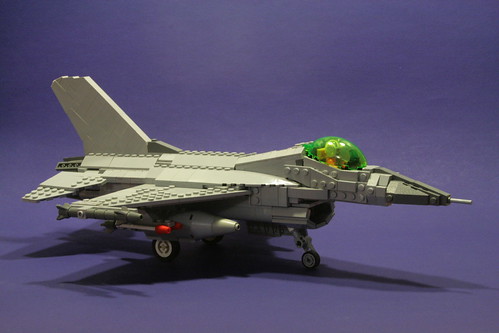
A very detail-oriented builder, Mike Psiaki has been tweaking his F-16 Fighting Falcon for some time now. Though it's still a work in progress, I think it's safe to say that it's sufficiently developed to blog here. The new canopy from the Atlantis sets works perfectly for the cockpit, and the neon green works remarkably well, as fighter cockpits often have green glows to them from their heads-up displays. Otherwise, there are lots of interesting angles that doubtlessly have been achieved by only by very intricate SNOT work, but the payoff is that the model resembles its real-life counterpart down to every last angle. It's easily one of the best models that I've seen lately, and is all the more cool to see as the F-16 is my favorite fighter.


Saturday, 3 April 2010

LEGO Military Build Challenge #3: Rescue!

As usual at the end of a build challenge, I bring you my own overview of the various submitted models. It's a bit shorter than the previous two, quite simply because we had fewer entries. I'm hoping this means that everybody had plenty of ideas of their own rather than that we've chosen a poor subject.

It certainly got creative juices flowing with cm946. His entry for this challenge is probably also the most imaginative or weirdest depending on your point of view. I won't make any statements either way, it is called the Monkey Search and Reskewer, and according to the background story (for which you need to click the picture) was used to 'fend off abnormally large Sharks, of both the Sky and Sea varieties'.
Monkey Search an' Reskewer
Actually, I will make a statement: dude, I don't know what you've been sniffing, but I wouldn't be surprised if it's illegal (only joking).

I wasn't sniffing anything other than a sea breeze when I got the idea for my own entry. In the last few months I took two trips to Den Helder in the North of The Netherlands, visiting the Royal Netherlands Naval College. Den Helder is the home base for the Dutch Navy's SH-14D Lynx helicopters, and that's what I decided to build.
Royal Netherlands Navy SH-14D Lynx (1)
One of their missions is Search-and-Rescue over the North Sea.

Necessity is the mother of invention. What do you do if a) your troops desperately need food or ammo and b) you don't ave any dedicated cargo aircraft or helicopters? Brickgeek's solution is the Osprey 1, a crop duster turned into a multi-purpose support aircraft.
Osprey1


Some of us may still be building HumVees, but my fellow blogger Chandler Parker is already looking forward to the HumVee's successor: the Joint Light Tactical Vehicle, building an ambulance version.
Joint Light Tactical Vehicle ambulance
Among other goodies it has working suspension and a cleverly constructed windscreen. It's also hard to beat the effective simplicity of a brick-built red cross logo.

For this challenge, Imagelego came up with a type of vehicle that I am sure neither Chandler or I thought of when we started the challenge -a recover tank. However, it's very fitting nonetheless and a very nice build. He builds tanks on a somewhat smaller scale than most military builders, but manages to make them more detailed than many larger vehicles I've seen over the years.
VT-55 (2)
Good stuff. I'm hoping we'll get a few entries of this level for the combat engineering category of this year's build contest, although they'll make my task as a judge a bit harder.

We may not have had many entries this time around, but the very prolific Aleksander Stein apparently felt that he could make up for that just on his own by building multiple entries. The first is a wrecker version of a military truck.
JDI Titan FH350R wrecker
I think this is the sort of vehicle that is often overlooked by LEGO military builders -part of the reason for the combat engineering category in the contest. Their utilitarian looks doesn't make them pretty, but Aleksander's truck definitely looks the part.
Like the US Military's HumVee, Aleksander's Dragoon vehicle comes in a whole variety of different versions. His second entry is an armoured ambulance version.
KMV/Hägglunds Dragoon armoured ambulance
To top it all off, he's combined both vehicles in an action-packed diorama.
Road to ruin
Awesome.

The American truck manufacturer Oshkosh is mostly known for builsing the HEMTT heavy tactical trucks for the US military as well as specialised vehicles for fire fighting and the construction industry. Bruno Vaiano's entry is a combination of both: the TFFT is an airport fire tender based on the HEMTT truck chassis.
Oshkosh TFFT
Bruno reckons it is his best military MOC to date and I am inclined to agree.

From my own entry I hope it is obvious that I like helicopters, I'm very happy that we had a three helicopters as last-minute entries. Ninja Pilot's helicopter is called the SS 40 Griffin.

I love the colour scheme (reminiscent of the colours used by the Canadian Armed Forces) and the working doors in particular -no small feat on a minifig scale helicopter.

Babalas Shipyards took some time out from building his massiveWW II Fletcher class destroyer to build the RH-21 Black Swan, also built to minifig scale and featuring working sliding doors as well as a retractable undercarriage.
RH-21 Black Swan02

The final entry of this challenge is a model of the classic UH-60 Blackhawk byGravel Cruncher, a helicopter type that is also used for missions such as Combat Search and Rescue.

Many other people have built Black Hawks, but what is special about this one is how many minifigs it can fit in spite of its modest size.

In numbers this may not have been our most successful challenge, but we did get some nice entries out of it and I'd like to thank everybody who did go to the trouble of building something. Chandler and I will be announcing a next challenge after the current build competition ends.