
Dubbed Stalin's organ by German troops during WWII because of its resemblance to a musical organ, the Katyusha still sees service today.
Tuesday, 29 March 2011
Stalin's organ
Ralph and I have been busy helping organize the annual LEGO military contest, so that's probably one reason why we haven't updated this blog much lately. But just to remind our readers that we're still alive, here's an excellent diorama by pepik_ that features a Katyusha rocket launcher mounted on a Studebacker US6 truck:


Saturday, 12 February 2011
Achtung, Spitfire!
Ed Diment built a wonderful rendition of the Supermarine Spitfire for the Flickr LEGO military build contest two years ago. So, how do you top that? By building a Spitfire twice as large!

Damn, I wish I had time to build!
Damn, I wish I had time to build!
Wednesday, 9 February 2011
Land Rover Wolf
A little over two years ago, I built a model of the Land Rover Wolf, a militarized version of the Land Rover Defender that's used extensively by the British Army:


As you can see, it was pretty rough, but then again, it was my first model of a real-life vehicle. After the apparently arbitrary deletion of the LEGO 16+ group on flickr recently (which has since been replaced by a new group, AFOL 16+, but I'm getting off topic), I thought that it'd be a good idea to back up the photos in the flickr photostream. While doing so, it occurred to me that it might be fun if I rebuilt some of my old creations, seeing as my building skills have improved quite a bit over the years. The Land Rover Wolf seemed like as good a place to start as any, and within a couple of days, I had built a new model:
After posting it on flickr, Tim Ltd and Aleksander Stein pointed out that the cab was disproportionately big, and that it'd look much better if it was shortened by one stud. I at first wasn't sure that it could be done, but after having another look at Aleks's Wolfhound family of vehicles, I realized that the technique that he used to build the doors on them could be adapted to fit my Landy. After making a few other changes, I posted the revised version:
Meanwhile, Aleks had decided to build his own version of my Landy, which he dubbed the Radio Wolf, a communications version of the Land Rover Wolf, which, among other changes, he built in the camo scheme of his faction, the Nordic Defense Council, and a used a technique for the canvas that he had previously used on one of his Wolfhounds:
Tim (the aforementioned Tim Ltd) has also said that he might try his hand at building his own version of my Landy as well. I hope I haven't bored you all (our readers, that is) too much, but I thought that some of you might it find it interesting that simply building something can turn into a community project of sorts.
Sunday, 30 January 2011
Tinkering with Tomcats
A new cat on the block
Ever since I moved my pictures to flickr at the expense of my account on MOCPages, I haven't looked at the latter site much. This morning I did visit MOCPages and came across a very interesting model of the Grumman F-14 Tomcat built by Joshua Ciesielski. He has some very flattering things to say about my Tomcats (much more about those later), but I first want to take a closer look at his model. The overall shape is reasonably accurate, but most impressive about the model in my opinion are the working features.

The Tomcat was designed in the late nineteen-sixties as a replacement for the classic F-4 Phantom. The conflicting requirements of low landing speeds and a high top speed were met by Grumman by giving their design variable geometry wings. For low speeds and for long range cruise the wings were swept out, while for high speed flight (and storage aboard carriers) the wings were swept aft. Several aircraft that appeared around this time had this feature, including the F-111, MiG-23, Panavia Tornado and the B-1B. Among these the Tomcat stood out for being the only one where the wing position was computer controlled and the actuators were strong enough to move the wings whilst the aircraft was maneuvering, optimising the sweepback angle of the wing for the Mach-number (the ratio between the airspeed of the jet and the local speed of sound). This not the easiest thing in the world to get right on a LEGO model.

The speed of sound plays a big role in the aerodynamics of jet fighters. Conventional jet engines require vast amounts of air in their intakes, but the flow at the front face of the engine should be should be below the speed of sound (the Mach number should be less than 1). If the plane itself is flying at supersonic speeds, this means that the air in the inlet needs to be slowed down, which is done by designing the inlet such that one or more shock waves occur in the flow.
Many modern planes have fixed intakes, but aircraft designed for high supersonic speeds such as the F-15 and the Tomcat the inlet performance is optimised for each Mach number (as well as a few other parameters such as the throttle setting and the air temperature) by changing the angle of a series of ramps built into the inlet. Much to my amazement, Joshua managed to fit moveable ramps in the inlets of his Tomcat.

In addition to these working features, the model has a retractable undercarriage covered by doors when retracted, working flaps, slats, rudders and tailerons (control surfaces), moveable air brakes, and an opening cockpit (although it doesn't quite open the way it should due to limitations of the canopies LEGO makes).
Tomcat evolution
I'm no stranger to Tomcats myself, so I can appreciate how much work went into Joshua's model. One of the first models of mine to appear on-line was my F-14D Tomcat model 'Vandy One', which I posted on brickshelf and MOCpages way back in 2005. It was also featured in an article in issue 2 of Brickjournal.

It was the result of a gradual process of improvement that took place over many years. The picture below shows the collection of LEGO jet fighters that I had in around 1995. The Tomcat model I had at the time is on the far right.

Comparing it to Vandy One it's obvious that there are many similarities. Whole sections of the model are built exactly the same. The differences, however, are more interesting. Note, for instance, the almost complete lack of SNOT building on the glove vanes (the sections between the jet intakes and the wing roots) and how crude the nose radome looks. The colour scheme of the old model is also noteworthy. Operational Tomcats were usually grey all over, but I didn't have enough grey LEGO at the time to build it properly. One thing that I did already have was a mechanism for synchronising the wing sweep, which has since been copied by several builders -including Joshua- and is shown below exposed on the latest incarnation of Vandy One.

.
In the years since I posted Vandy One on-line I've kept tinkering with my Tomcats, improving Vandy One and making similar changes to my second Tomcat model -an F-14A in markings carried by jets aboard USS Nimitz in 1978.

Vandy One received new wings -built using 2-3 wedge plates - and using other new parts the shape of the nose was modified yet again. The tailfins were completely rebuilt, giving their leading edge a more accurate slope. It also received new exhausts, replacing the older ones built with bricks and slopes and more closely representing the large afterburner cans of the F110 engines that powered the F-14D, and some of the stickers were replaced. The model that represented the older F-14A from Nimitz received new markings and new exhaust nozzles as well, representing the engine nozzles of the TF30 engines that powered most Tomcats.

Finally, last year I got around to building a Tomcat in the grey markings that were most common on operational Tomcats since the early 'eighties, choosing to model an F-14A of VF-14 'Tophatters' that was aboard USS Enterprise in 2001.

Tomcats by other builders
The Tomcat turned out to be as much as a classic as the F-4 Phantom that it replaced and it is no surprise to me that it is a popular model to build out of LEGO. One of the first LEGO Tomcats that I saw on-line was Bryce Rollins'. He doesn't seem to be as active as he used to be, but back in 2005 he was constantly posting new models he designed in L-Draw, including many different Tomcat models. When I first saw them I was struck by how similar they were to mine, even though Bryce could have never seen mine. Great minds and all that!

Another 'virtual' builder is J. Stan over on flickr. In my opinion, one of the outstanding features on his Tomcat model (designed in Lego Digital Designer) is the way he slanted the intakes. It's something I tried on my Tomcat model many yeara ago, but couldn't manage to look good.


Another nice Tomcat model is the one by Scott Behne, also on MOCpages. I remember seeing this back when I was still a member and liking it back then, apart from some weirdness going on at the nose. It's still one of the best out there, also with slightly tilted intakes.

Last but not least, for the last few years Mechanized Bricks have been selling a custom set of the F-14. It's not cheap, but is rather nice. Their site doesn't allow me to hot-link to picture, but I managed to find pictures of a built model (without decals) on brickshelf.

Ever since I moved my pictures to flickr at the expense of my account on MOCPages, I haven't looked at the latter site much. This morning I did visit MOCPages and came across a very interesting model of the Grumman F-14 Tomcat built by Joshua Ciesielski. He has some very flattering things to say about my Tomcats (much more about those later), but I first want to take a closer look at his model. The overall shape is reasonably accurate, but most impressive about the model in my opinion are the working features.
F-14D Tomcat model by Joshua Ciesielski.
The Tomcat was designed in the late nineteen-sixties as a replacement for the classic F-4 Phantom. The conflicting requirements of low landing speeds and a high top speed were met by Grumman by giving their design variable geometry wings. For low speeds and for long range cruise the wings were swept out, while for high speed flight (and storage aboard carriers) the wings were swept aft. Several aircraft that appeared around this time had this feature, including the F-111, MiG-23, Panavia Tornado and the B-1B. Among these the Tomcat stood out for being the only one where the wing position was computer controlled and the actuators were strong enough to move the wings whilst the aircraft was maneuvering, optimising the sweepback angle of the wing for the Mach-number (the ratio between the airspeed of the jet and the local speed of sound). This not the easiest thing in the world to get right on a LEGO model.
F-14D Variable geometry wings by Joshua Ciesielski.
The speed of sound plays a big role in the aerodynamics of jet fighters. Conventional jet engines require vast amounts of air in their intakes, but the flow at the front face of the engine should be should be below the speed of sound (the Mach number should be less than 1). If the plane itself is flying at supersonic speeds, this means that the air in the inlet needs to be slowed down, which is done by designing the inlet such that one or more shock waves occur in the flow.
Many modern planes have fixed intakes, but aircraft designed for high supersonic speeds such as the F-15 and the Tomcat the inlet performance is optimised for each Mach number (as well as a few other parameters such as the throttle setting and the air temperature) by changing the angle of a series of ramps built into the inlet. Much to my amazement, Joshua managed to fit moveable ramps in the inlets of his Tomcat.
F-14D Tomcat variable geometry inlet by Joshua Ciesielski.
In addition to these working features, the model has a retractable undercarriage covered by doors when retracted, working flaps, slats, rudders and tailerons (control surfaces), moveable air brakes, and an opening cockpit (although it doesn't quite open the way it should due to limitations of the canopies LEGO makes).
Tomcat evolution
I'm no stranger to Tomcats myself, so I can appreciate how much work went into Joshua's model. One of the first models of mine to appear on-line was my F-14D Tomcat model 'Vandy One', which I posted on brickshelf and MOCpages way back in 2005. It was also featured in an article in issue 2 of Brickjournal.
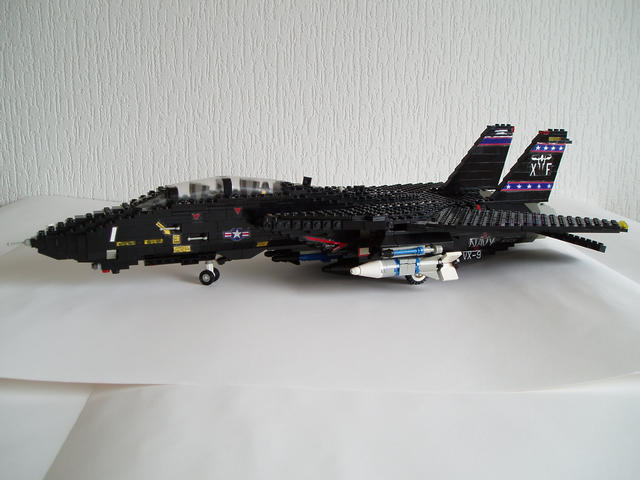
F-14D Tomcat model as it appeared in 2005.
It was the result of a gradual process of improvement that took place over many years. The picture below shows the collection of LEGO jet fighters that I had in around 1995. The Tomcat model I had at the time is on the far right.
Fighter collection by Mad Physicist in 1995.
Comparing it to Vandy One it's obvious that there are many similarities. Whole sections of the model are built exactly the same. The differences, however, are more interesting. Note, for instance, the almost complete lack of SNOT building on the glove vanes (the sections between the jet intakes and the wing roots) and how crude the nose radome looks. The colour scheme of the old model is also noteworthy. Operational Tomcats were usually grey all over, but I didn't have enough grey LEGO at the time to build it properly. One thing that I did already have was a mechanism for synchronising the wing sweep, which has since been copied by several builders -including Joshua- and is shown below exposed on the latest incarnation of Vandy One.
Mechanism for synchronising the wing sweep by Mad Physicist.
In the years since I posted Vandy One on-line I've kept tinkering with my Tomcats, improving Vandy One and making similar changes to my second Tomcat model -an F-14A in markings carried by jets aboard USS Nimitz in 1978.
'Vandy One' after its latest rebuild.
Vandy One received new wings -built using 2-3 wedge plates - and using other new parts the shape of the nose was modified yet again. The tailfins were completely rebuilt, giving their leading edge a more accurate slope. It also received new exhausts, replacing the older ones built with bricks and slopes and more closely representing the large afterburner cans of the F110 engines that powered the F-14D, and some of the stickers were replaced. The model that represented the older F-14A from Nimitz received new markings and new exhaust nozzles as well, representing the engine nozzles of the TF30 engines that powered most Tomcats.
F-14A Tomcat of VF-84 Jolly Rogers by Mad Physicist.
Finally, last year I got around to building a Tomcat in the grey markings that were most common on operational Tomcats since the early 'eighties, choosing to model an F-14A of VF-14 'Tophatters' that was aboard USS Enterprise in 2001.
F-14A Tomcat model by Mad Physicist.
Tomcats by other builders
The Tomcat turned out to be as much as a classic as the F-4 Phantom that it replaced and it is no surprise to me that it is a popular model to build out of LEGO. One of the first LEGO Tomcats that I saw on-line was Bryce Rollins'. He doesn't seem to be as active as he used to be, but back in 2005 he was constantly posting new models he designed in L-Draw, including many different Tomcat models. When I first saw them I was struck by how similar they were to mine, even though Bryce could have never seen mine. Great minds and all that!
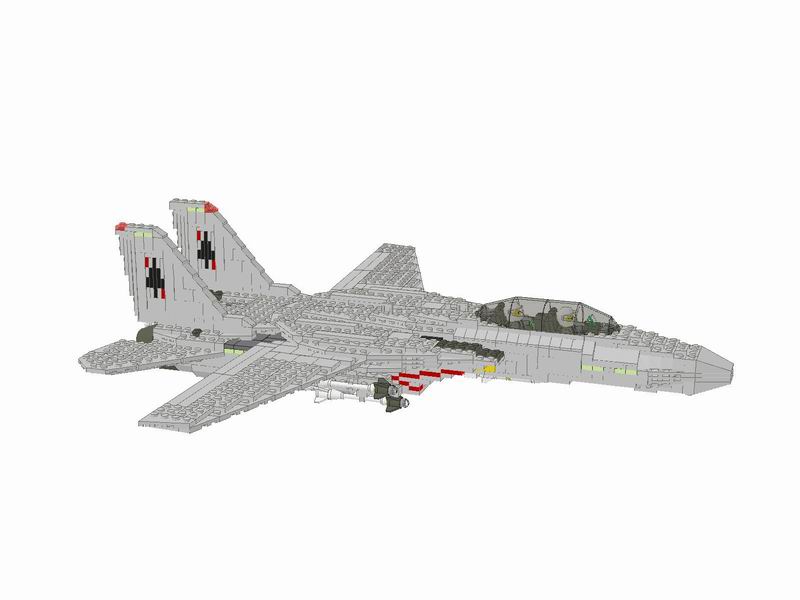
One of Bryce Rollins' L-Draw Tomcat models.
Another 'virtual' builder is J. Stan over on flickr. In my opinion, one of the outstanding features on his Tomcat model (designed in Lego Digital Designer) is the way he slanted the intakes. It's something I tried on my Tomcat model many yeara ago, but couldn't manage to look good.
F-14A Tomcat model by J. Stan.
F-14A Tomcat model by J. Stan.
Another nice Tomcat model is the one by Scott Behne, also on MOCpages. I remember seeing this back when I was still a member and liking it back then, apart from some weirdness going on at the nose. It's still one of the best out there, also with slightly tilted intakes.
F-14D Tomcat model by Scott Behne.
Last but not least, for the last few years Mechanized Bricks have been selling a custom set of the F-14. It's not cheap, but is rather nice. Their site doesn't allow me to hot-link to picture, but I managed to find pictures of a built model (without decals) on brickshelf.
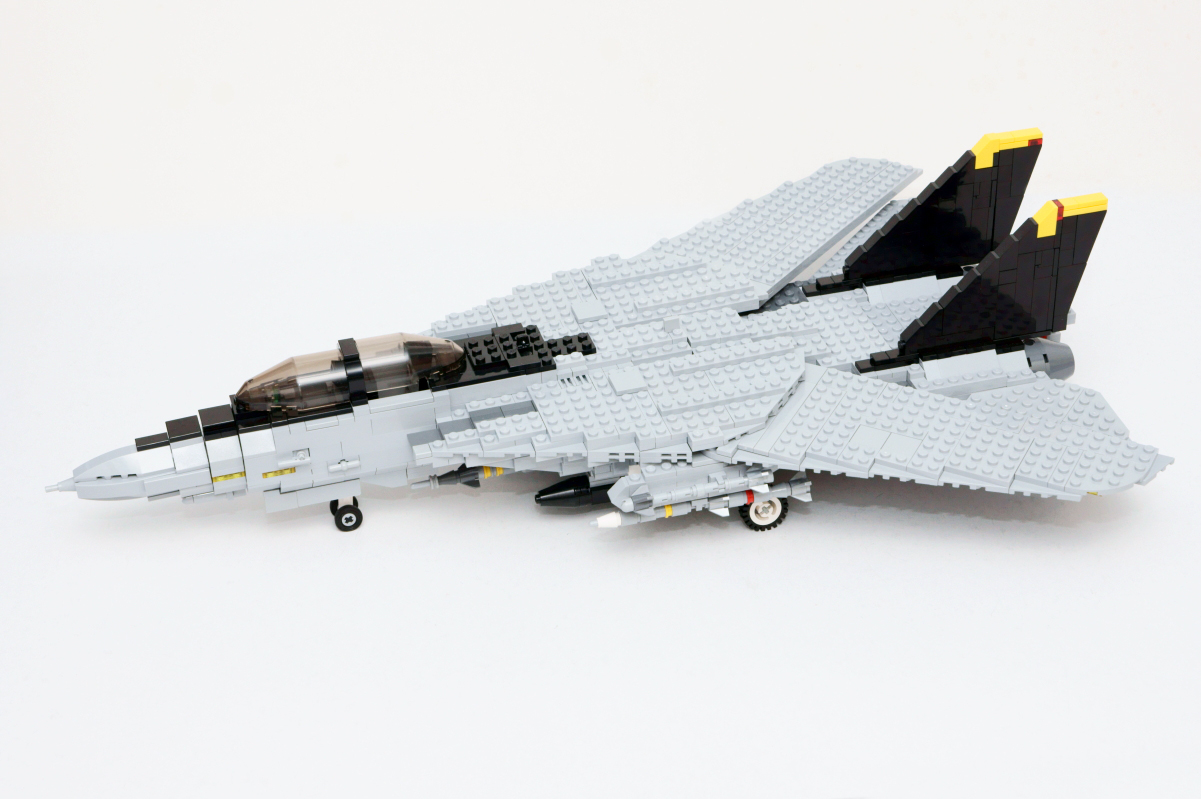
F-14 Tomcat model from Mechanized Bricks, built by Brickshelf user 3e3e3e.
Wednesday, 12 January 2011
Achtung, Messerschmitt!

Many of the military MOCs I've built in 2010 were WW-II military aircraft. In fact, most of the aircraft I've built in about two years time are WW-II military aircraft. So, it'll be obvious that they interest me. So, what gets me to write something for the first time in months? Of course, a WW-II military aircraft!
Legohaulic built a very nice rendition of the German Messerschmitt Bf 109 a few years ago, but wasn't happy about the scale. So, he's had another go, with this very nice result.

Note the subtle dihedral of the wings and the clever use of wedge plates to break up the camouflage!
Monday, 6 December 2010
LMMBC #2 roundup
While LMMBC #2 didn't produce quite as many entries as our first build challenge, we still received 14 entries, which is a very respectable turnout, if you ask me.


Our first entry is by Tim Ltd, who is apparently currently at a university with a limited supply of bricks. He still managed to build this neat little AA gun, which I can envision mounted on a naval vessel of some type.
Next up is a Tunguska tracked AA system by Snuffwuzz >.<, rendered in LDD. Unfortunately, tracks aren't available in the program, so he substituted wheels for them. That doesn't make this model any less impressive, however.
Chris C(from the UK) also has rendered his entries, a ZU-23-2 and a Rapier missile system (both towed AA systems) in LDD.
Carpet Legos has built a FlaK 88, and though he says that this is merely the latest version of a model that he built some time ago, it's highly detailed and is a nice entry nonetheless.
The Legonator turned to microscale for this build challenge and built a very cool AA train, as well as a number of different AA systems.
Tyler TJM's FlySwatter II AA system is built into a tank turret, to act as a defense against aircraft if the tank is without air support. I like the fact that it's concealed, and ready to give a helicopter or low-flying fighter an unpleasant surprise.
Babalas Shipyards has built a pair of Phalanx CIWS on latest work in progress, a massive Royal Navy frigate. They're a dead ringer for the real thing, and, just like the real thing, look like some well-armed version of R2-D2 from Star Wars (as they're sometimes nicknamed in real life).
Like The Legonator, I also turned to microscale for this build challenge, and built a diorama of US forces smashing their way through German lines in Saint-Lô during Operation Cobra in July 1944.
Next up, sniper151516 built an AA version of a Lynx light tank. The photography is a bit grainy, but that doesn't change the fact that it's an excellent and very detailed creation.
And, last, but not least, Aleksander Stein has built the XA-386 Vanguard, and AA version of his XA-380 AMV (Armored Modular Vehicle). Though it's merely a back-up for his main entry, which he wasn't able to finish in time, it's still a definite highlight of the build challenge.
Saturday, 30 October 2010
Trapped Under Ice
Imagelego always builds interesting creations, and his latest diorama is no exception, which depicts a tank stuck in ice. The use of round transparent plates mixed in with plates works well as melting, slushy ice, and the way the tank is partially submerged on an angle also adds to the realistic nature of the dio.

Whoever gets what the title is referencing gets a cookie.
Subscribe to:
Posts (Atom)