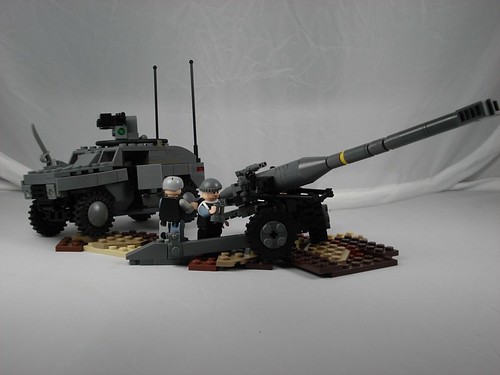
My basic modular landscape elements are essentially an interlinking system of large sloped elements that can be out together in various configurations and that all come up to the same height – three bricks and one plate. Two basic sloped elements can form a valley, a ridgeline, or a hillside. Two different corner slope types (double convex and double concave) are essential to basic hill formations. If I want a hillside more than one module high, I can stack elements behind one another, almost like steps on a staircase. So long as I support the raised elements from below (Duplo is excellent for this), there is no real limit to how high I can go.
 My first basic elements were built on 32 by 32 stud baseplates, but as I found myself building more and more of these, I realized I wanted more variety to keep things interesting. I built modular river elements, and soon added pathways and smaller sloped elements, on 32 by 16 and 16 by 16 stud elements.

At some point I realized that it was going to be very cumbersome to figure out how to place dozens of large baseplates on a big table all at the same time. So I came up with a scaled down version of my landscape standard, using a 4 by 4 plate representing each 32 by 32 stud landscape element. I called these scaled down plates my “planning tiles” because I use them to plan my big dios. They allow me to experiment with different landscape arrangements on a small tabletop. If I am trying to come up with a design for a large hill for instance, and I run out of a certain kind of corner slope, I can either redesign the hill to work with slopes I have, or I can build the remaining corner slopes I need to complete the hill.
 Over the course of the year I started using my landscape modules for small dioramas, displays maybe taking up to one table worth of space.

By the time BrickFair2010 was on the horizon, I had over 60 baseplates worth of landscape, which could be complemented by regular flat baseplates. I was excited about putting all my MOCs on display, but at some point I thought it might be interesting to open the dio up to other builders too, to turn it into a collaborative project. I knew that many of the leading builders in the military community were coming to BrickFair, and I approached some of them about the project. In the end, various builders contributed to the layout with a combination of vehicle MOCs, figs, extra baseplates, foliage and brick built trees, and best of all, a few modular elements built to the specification of my landscape standard.
One of the challenges of coming up with a community build project for the military theme is that we all essentially build in different mutually exclusive subthemes – whether WWII, modern, sci-fi, or whatever else. No matter how great the best military MOCs look, they won’t look cool all together on the same battlefield. So instead of everyone displaying together, we took turn displaying our MOCs and figs, in different themed settings. I came up with a large battlefield setup that could be split in half when needed, and we ended up going with various battlefield scenarios on different days. With John Rudy’s Gettysburg gatehouse and Chandler’s road elements, we had a huge layout of 84 baseplates to spread our MOCs over – almost four full tables worth!
Here are a few pictures of the maps I came up with for the display, using the planning tiles:


And when put together:

I had never set up so many landscape elements together before, and while I had mapped it all out in advance with my planning tiles, I wasn’t entirely sure that it would work in practice. Would the tops of the tables match up evenly enough? Would I have enough bricks to place underneath raised landscaping to elevate the terrain? I was quite relieved when everything came together exactly as planned.
When we first set up, Chandler and Aleksander Stein set up their realistic modern MOCs on what I called the “West Battlefield”, while Carter Baldwin and various other sci fi builders set up a big futuristic style battle on the “East Battlefield”. Each of these dios was on a 6 by 7 baseplate area.


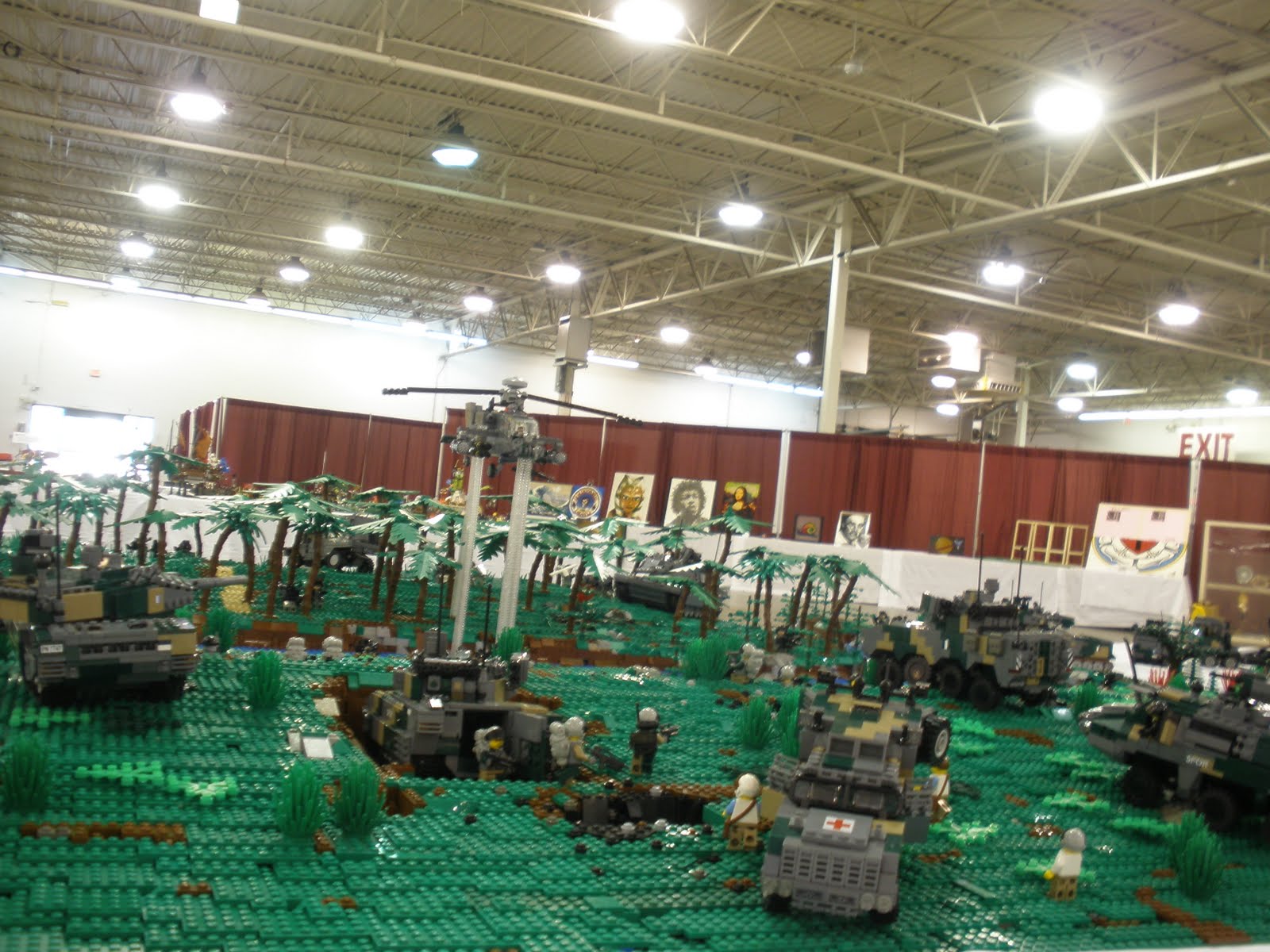
The next day we removed all the vehicles and figs, and pushed the two battlefields together to create a huge 6 by 14 size battlefield, and my fictional CBU and NBR factions duked it out on the full size diorama.


For the final battles we split the field in two again, and Dan Siskind set up a terrific WWII Pacific theatre style dio on the East Battlefield, while Casey Mungle took over the West Battlefield with his 700 odd Napoleonic style troops.


Seeing all this come together for a full weekend was really a huge thrill. Adding landscape really take a military setup to the next level, compared to just displaying MOCs on a table. All of a sudden your troops can actually take cover behind hills, river banks, and in foxholes or trenches. Best of all, any LEGO vehicle that is built in the same colors as the landscape becomes genuinely camouflaged - and viewers have to spend a little more time by the dio to catch all the little details.
I’d like to thank everyone who participated in this project, either by building something for it, or by helping me with setup and teardown. I can only hope to put on something similar, and hopefully larger, next year. I’m not quite sure what that will involve, but my river definitely needs some kind of a bridge, and I’d also like to add more buildings and possibly other features to add variety and color to the display. I’m thinking train tracks, rock formations/mountains, and definitely more in the way of trenches and bunkers.
Feel free to make any suggestions. My modular landscape system is still very much a work in progress!



The next day we removed all the vehicles and figs, and pushed the two battlefields together to create a huge 6 by 14 size battlefield, and my fictional CBU and NBR factions duked it out on the full size diorama.


For the final battles we split the field in two again, and Dan Siskind set up a terrific WWII Pacific theatre style dio on the East Battlefield, while Casey Mungle took over the West Battlefield with his 700 odd Napoleonic style troops.


Seeing all this come together for a full weekend was really a huge thrill. Adding landscape really take a military setup to the next level, compared to just displaying MOCs on a table. All of a sudden your troops can actually take cover behind hills, river banks, and in foxholes or trenches. Best of all, any LEGO vehicle that is built in the same colors as the landscape becomes genuinely camouflaged - and viewers have to spend a little more time by the dio to catch all the little details.
I’d like to thank everyone who participated in this project, either by building something for it, or by helping me with setup and teardown. I can only hope to put on something similar, and hopefully larger, next year. I’m not quite sure what that will involve, but my river definitely needs some kind of a bridge, and I’d also like to add more buildings and possibly other features to add variety and color to the display. I’m thinking train tracks, rock formations/mountains, and definitely more in the way of trenches and bunkers.
Feel free to make any suggestions. My modular landscape system is still very much a work in progress!